







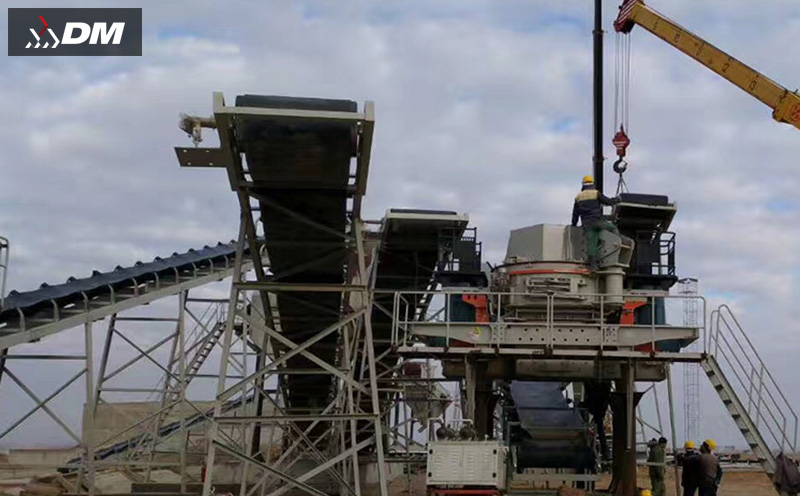
I. Core Pain Points of Crushing Operations in Kenya: Poor Adaptability, Low Efficiency, and High Costs
Kenya's mineral resources (gold mines in the Western Greenstone Belt, limestone mines in the east, titanium mines along the coast) and infrastructure projects (Nairobi Ring Expressway, rural affordable housing, commercial complexes) exhibit distinct "diversified demand" characteristics: on the raw material side, different mineral types vary greatly in hardness, humidity, and mud content (e.g., gold ore is hard, while limestone has high mud content); on the product side, there are both 0-40mm coarse aggregates for road construction and 0-5mm high-quality manufactured sand for concrete pouring; on the capacity side, small mining enterprises need small-capacity equipment of 30 tons per hour, while large building materials enterprises require large-scale production lines of 2000 tons per hour.
Traditional crushing production lines struggle to meet these complex demands: fixed processes cannot adapt to diverse raw materials, often leading to material blockages and mismatched capacity; manual operations are cumbersome, resulting in low per capita efficiency and high labor costs; capacity expansion requires rebuilding production lines, causing serious waste of long-term investment; at the same time, Kenya's environmental protection policies are becoming increasingly stringent, and traditional equipment emits excessive dust and noise, making it prone to suspension for rectification. These pain points have left many enterprises trapped in the dilemma of "inappropriate equipment, low efficiency, and inability to reduce costs."
II. Core Advantages of Modular Crushers: On-Demand Customization, Full-Scene Adaptation + Maximum Benefits
Modular crushers take "scientific process planning as the core, modular design as the support, and automation + environmental protection as the guarantee," solving pain points comprehensively from raw material adaptation, capacity customization, operational efficiency to long-term expansion, and becoming the preferred solution for multi-scene crushing in Kenya:
1. Scientific Process Planning, Precisely Adapting to Raw Material and Product Needs
Unlike traditional fixed processes, the core of modular crushers is "tailor-made" full-process planning: a professional team of engineers first conducts an in-depth analysis of the customer's raw material characteristics (size, hardness, humidity, mud content) and target product standards, then scientifically configures a complete process chain of "primary crushing - secondary crushing - tertiary crushing - screening - dust removal."
This customized planning ensures smooth capacity matching of all links in the system, avoiding "front-end blockage and back-end idleness" or "capacity waste"; at the same time, through optimized process layout and automatic control, it maximizes operational benefits——per capita production efficiency is increased by up to 30% compared with traditional equipment, and Overall Equipment Efficiency (OEE) is stably maintained above 85%, enabling each batch of raw materials to be efficiently converted into qualified products. For example, when processing limestone with high mud content, a sand washing module is added in the screening link to ensure the purity of finished aggregates; when processing hard gold ore, the wear resistance of the primary crushing module is enhanced to extend equipment service life.
2. High Modularity + Automation, Cost Reduction, Convenience and Efficiency
The production line adopts a highly modular design, with core units such as feeding, crushing, screening, and conveying as independent modules, featuring reasonable layout and smooth connection. The installation and commissioning cycle is 60% shorter than that of traditional production lines. More importantly, the equipment is equipped with a centralized control system, allowing operators to complete full-line start-stop, crushing parameter adjustment, and equipment operation status monitoring in the control room without on-site supervision.
This "modularity + automation" design brings significant cost reduction benefits: only 1-2 operators are needed for a single production line to complete the full-process operation, saving 80% of labor costs compared with the traditional manual operation mode; the standardized design of modules makes maintenance more convenient, reducing troubleshooting time by 50%; at the same time, automatic control ensures stable process parameters, increasing the qualified rate of finished products from 85% (traditional) to over 98%, reducing raw material waste.
3. Dual Customization + Strong Expandability, Adapting to Full-Cycle Development Needs
Modular crushers fully consider customers' short-term needs and long-term development from the initial design stage, realizing "on-demand customization + flexible expansion":
- Capacity customization: Supports full-range capacity design from 30 tons per hour to 2000 tons per hour. Small mining enterprises can start with small-capacity modules, while large enterprises can directly build large-scale production lines without paying extra for "unused capacity";
- Particle size customization: By adjusting the crushing gap and replacing the screen mesh, the finished product particle size can be precisely controlled between 0-40mm coarse aggregates and 0-5mm high-quality manufactured sand, meeting the needs of different projects without additional equipment;
- Strong expandability: Sufficient expansion interfaces are reserved. When capacity needs to be increased in the future, there is no need to rebuild the production line. Upgrades can be completed by adding crushing stages, replacing larger screening machines, or extending the conveying system, effectively protecting long-term investment value. For example, a small mining enterprise expanding from 50 tons per hour to 200 tons per hour only needs to add one set of secondary + tertiary crushing modules and link them with the original system, saving 70% of the cost compared with rebuilding the production line.
4. Environmentally Compliant Production, Meeting Kenya's Policy Requirements
Targeting Kenya's strict environmental protection policies, modular crushers adopt a "factory-style fully enclosed design + high-efficiency environmental protection system" to create a green production environment:
- Dust control: The entire line is equipped with fully enclosed corridors and high-efficiency pulse bag filter systems, reducing dust emission concentration by more than 95%, which is far below the limit value of Kenya's environmental protection standards;
- Noise control: Through systematic solutions such as equipment shock absorption design, enclosed factory sound insulation, and conveying system noise reduction, the overall working noise is reduced by approximately 50% compared with traditional equipment, avoiding noise pollution and environmental penalties;
- Sustainability: Full-process optimization reduces energy consumption and waste emissions, in line with Kenya's "green infrastructure" development orientation, helping enterprises establish an environmental protection benchmark image.
III. Practical Case in Kenya: Efficiency Revolution of Modular Equipment
A building materials enterprise in Nairobi specializes in limestone processing, supplying both 0-31.5mm coarse aggregates for road construction and 0-5mm high-quality manufactured sand for real estate projects. Previously, using traditional production lines, it faced problems such as "mismatched capacity, high labor costs, and excessive dust emissions." After introducing modular crushers, the enterprise achieved all-round upgrades:
- Process customization: Based on the characteristics of local limestone ("medium hardness, 8% mud content"), engineers configured a full-process of "jaw primary crushing + cone secondary crushing + impact tertiary crushing + three-layer screening + sand washing + dust removal" to ensure finished product quality;
- Capacity and particle size adaptation: The hourly capacity is customized to 300 tons, which can flexibly switch between "coarse aggregate mode" and "manufactured sand mode." The qualified rate of finished products is stably maintained at 99%, meeting the needs of different customer orders;
- Cost reduction and efficiency improvement: Centralized control allows the production line to be operated by only 2 operators, reducing labor costs by 75% compared with the previous 8-person team; the Overall Equipment Efficiency (OEE) reaches 88%, and the daily output is 25% higher than that of traditional equipment;
- Environmental compliance: The dust emission concentration is reduced by more than 95%, and the noise is decreased by approximately 50% compared with traditional equipment, successfully passing the acceptance of Kenya's environmental protection department, becoming a regional green production demonstration enterprise, and the order volume has increased by 40% compared with before.
The person in charge of the enterprise said: "The Kenyan market has fast-changing demands and strict environmental protection requirements. Modular crushers not only solve our need for 'one equipment for multiple purposes' but also help us save labor and pass environmental inspections. We don't need to rebuild for capacity expansion—this is truly the equipment suitable for us."
IV. Operation Optimization Suggestions for Modular Equipment in Kenya
To give full play to the advantages of modular crushers, combined with Kenya's market environment and operational characteristics, the following strategies are recommended:
- Policy adaptation: Communicate with local environmental protection departments in advance, optimize dust and noise reduction configurations according to regional environmental standards to ensure compliant operation; in response to Kenya's power supply characteristics, configure backup generator modules to avoid production interruptions due to power outages;
- Maintenance guarantee: Regularly check the sealing and fastening of module connection interfaces, especially做好 waterproof and rust-proof treatment during the rainy season; train professional operators to master the centralized control system to improve equipment operation and troubleshooting efficiency;
- Spare parts reserve: Reserve spare parts suitable for modules for vulnerable parts (such as crushing jaws, screen meshes) in advance to avoid downtime due to long import cycles;
- Process optimization: Timely adjust process parameters or add auxiliary modules (such as sand washing modules) according to changes in raw material characteristics (e.g., increased mud content during the rainy season) to ensure production stability.
Conclusion
Against the background of diversified crushing operation demands, strict environmental protection policies, and refined cost control in Kenya, modular crushers break many limitations of traditional equipment with the core values of "scientific process planning to maximize benefits, high modularity to adapt to full-scene needs, and strong expandability to protect long-term investment."
Whether it is the initial production of small mining enterprises, the multi-category supply of medium-sized building materials enterprises, or the large-scale processing of large projects, modular crushers can, through the comprehensive advantages of "on-demand customization, flexible expansion, cost reduction and efficiency improvement, and environmental compliance," become a key tool for Kenyan enterprises to solve crushing problems and enhance market competitiveness, injecting efficient, green, and sustainable new impetus into local mineral development and infrastructure development.
If you would like to get help immediately, you can also fill your requirements on the following form, we will contact you on the right time.


Get In Touch